FlowMNO
TL;DR
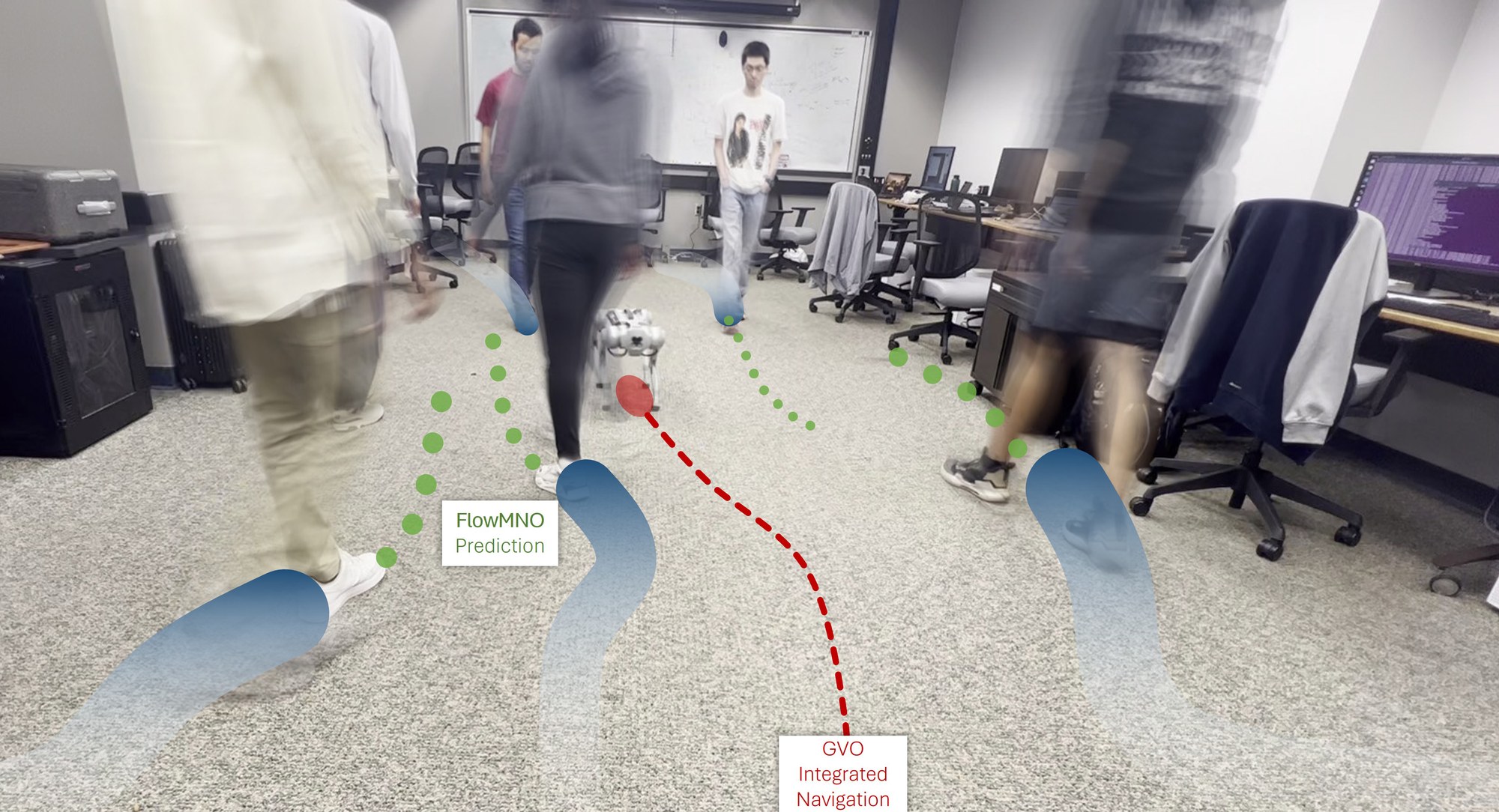
FlowMNO predicts pedestrian trajectories for robot navigation by combining optical flow with a Markov neural operator, treating motion as a Markov process so only the current state is needed. On the ETH, HOTEL, ZARA1, ZARA2, UCY and RGB-D pedestrian benchmarks it outperforms LSTM-, GAN- and CNN-based predictors by about 86%.
Method
Trajectory prediction as a Markov process
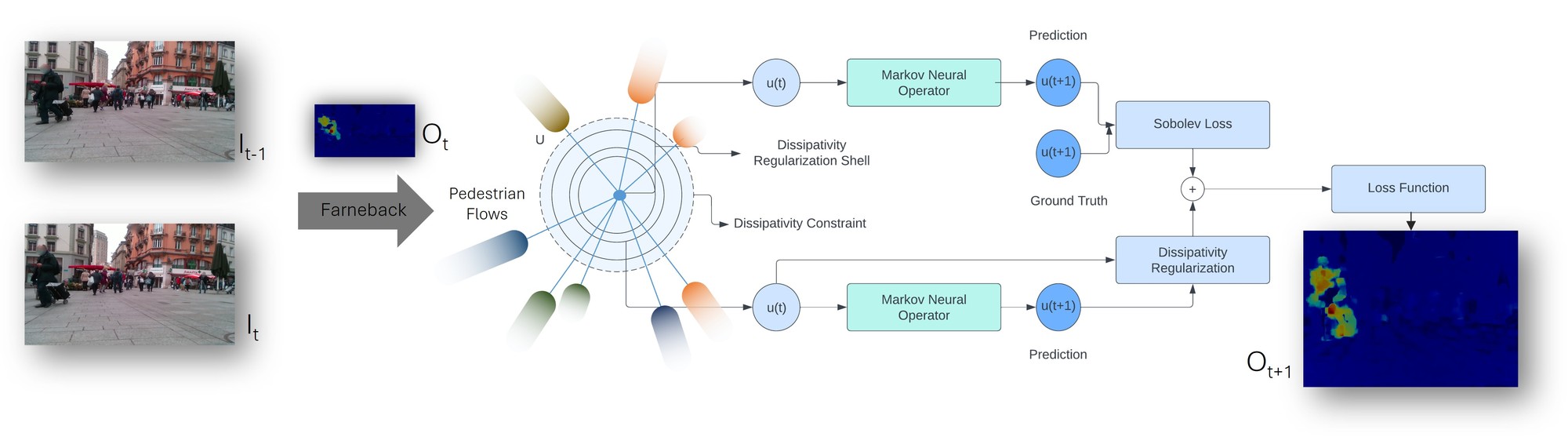
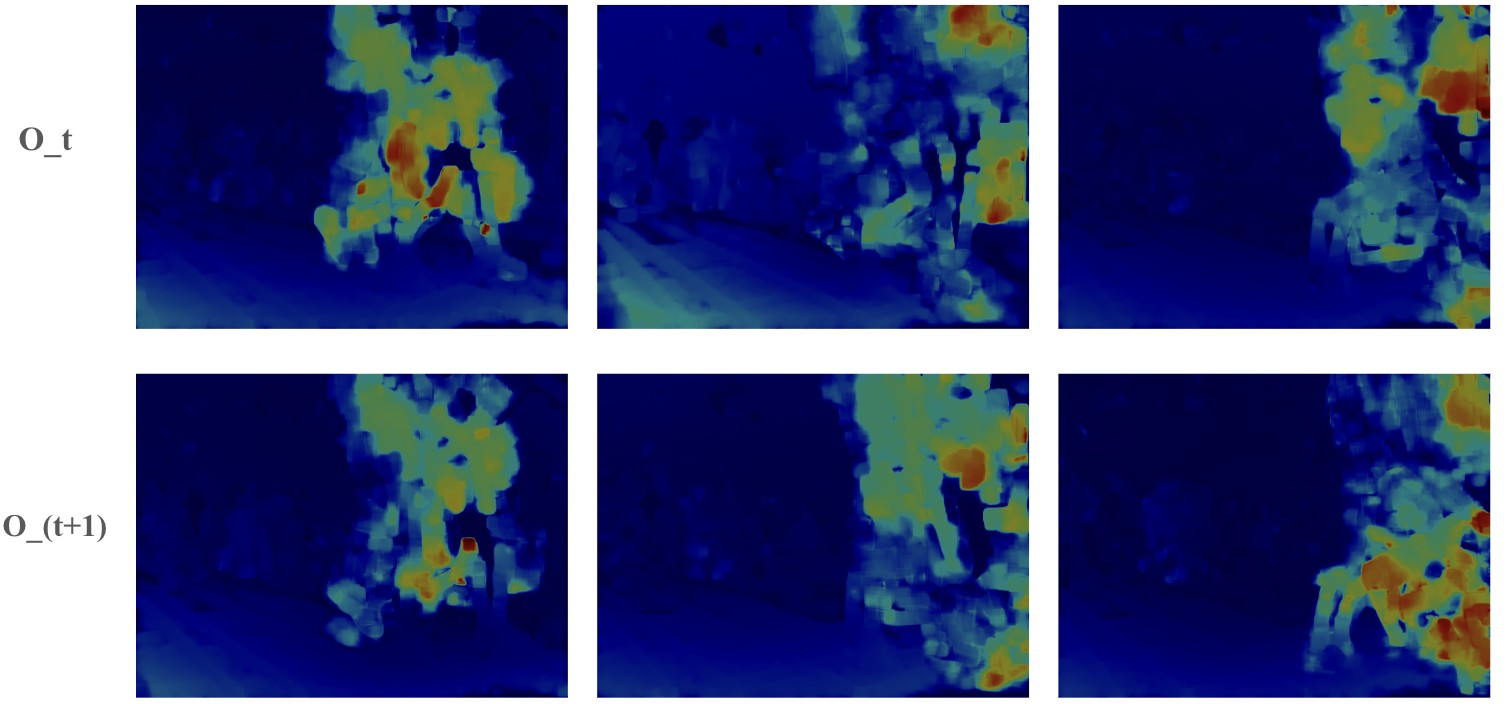
Pedestrians may change direction suddenly, so past states are a poor guide to the next one. FlowMNO therefore treats the crowd as a Markov process: the next state depends only on the current one, and no history has to be stored. Pedestrians are detected in each frame with YOLOv3-tiny and non-maximum suppression, and the motion between consecutive frames \(I_{t-1}, I_t\) is captured as a dense Farneback optical flow \(O_t\). A Markov neural operator then predicts the next flow field,
The operator learns the one-step solution map \(\hat S_h : f(t) \mapsto f(t+h)\) and is trained with a Sobolev-norm loss on the residual \(r = \hat S_h(f) - S_h(f)\), computed in Fourier space for \(p = 2\):
Composing \(\hat S_h\) with its own output gives long-horizon predictions, \(f(nh) \approx \hat S_h^{\,n}(f_0)\). Each pedestrian's next position \((x_{t+1}, y_{t+1})\) is read off \(O_{t+1}\) as the flow displacement at the centroid of their bounding box in frame \(I_t\).
Navigating among pedestrians
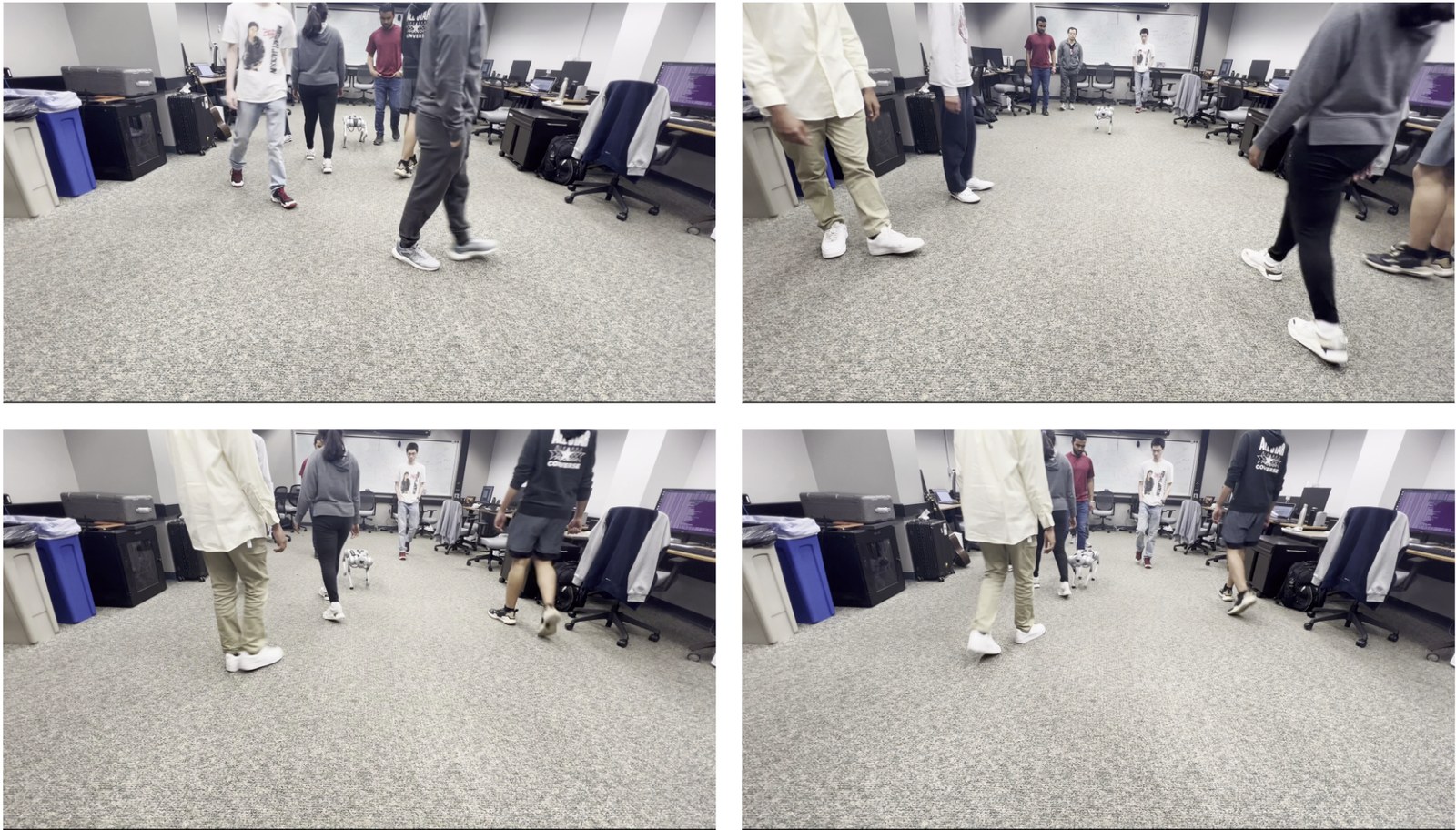
The predicted positions \((x_{t+1}, y_{t+1})\) become dynamic obstacles in the Generalized Velocity Obstacles (GVO) framework. For every pedestrian \(i\), GVO evaluates the relative velocity \(v_{r_i} = v_{r_\text{robot}} - v_{r_i^\text{pedestrian}}\) to assess collision risk and choose the robot's desired velocity.
Results
ADE / FDE (lower is better) against state-of-the-art deep learning methods on ETH and Hotel, Zara1, Zara2 and UCY. On the RGB-D pedestrian dataset FlowMNO reaches an ADE of 0.03 and an FDE of 0.04.
| Model | ETH | Hotel | Zara1 | Zara2 | UCY | Average |
|---|---|---|---|---|---|---|
| SSeg-LSTM | 0.15 / 0.295 | 0.05 / 0.08 | 0.05 / 0.08 | 0.07 / 0.1 | 0.1 / 0.16 | 0.08 / 0.15 |
| SS-LSTM | 0.2 / 0.37 | 0.08 / 0.13 | 0.08 / 0.11 | 0.07 / 0.12 | 0.2 / 0.24 | 0.13 / 0.19 |
| Scene-LSTM | 0.18 / 0.34 | 0.25 / 0.29 | 0.37 / 0.33 | 0.19 / 0.1 | 0.25 / 0.03 | 0.21 / 0.20 |
| Social-LSTM | 0.5 / 1.07 | 0.11 / 0.23 | 0.22 / 0.48 | 0.25 / 0.5 | 0.27 / 0.77 | 0.27 / 0.41 |
| Social-Attention | 0.46 / 4.56 | 0.42 / 3.57 | 0.21 / 0.65 | 0.41 / 3.39 | 0.36 / 4.45 | 0.38 / 3.49 |
| Starnet | 0.73 / 1.48 | 0.49 / 1.01 | 0.27 / 0.56 | 0.33 / 0.7 | 0.41 / 0.84 | 0.46 / 0.94 |
| SGAN (20V-20) | 0.61 / 1.22 | 0.48 / 0.95 | 0.21 / 0.42 | 0.27 / 0.54 | 0.36 / 0.75 | 0.39 / 0.78 |
| CNN-based | 1.04 / 2.07 | 0.59 / 1.17 | 0.43 / 0.90 | 0.34 / 0.75 | 0.57 / 1.21 | 0.59 / 1.22 |
| FlowMNO (Ours) | 0.04 / 0.02 | 0.02 / 0.01 | 0.05 / 0.09 | 0.01 / 0.02 | 0.02 / 0.04 | 0.03 / 0.04 |
ADE reduction
| FlowMNO vs. model | ADE reduction (%) |
|---|---|
| SSeg-LSTM | 50.00 |
| SS-LSTM | 69.23 |
| Scene-LSTM | 88.24 |
| Social-LSTM | 96.26 |
| Social-Attention | 98.88 |
| Starnet | 97.30 |
| SGAN (20V-20) | 96.72 |
| CNN-based | 98.06 |
| Average reduction | 86.46 |
Citation
@inproceedings{bhaskara2024trajectory,
  title     = {Trajectory Prediction for Robot Navigation using Flow-Guided Markov Neural Operator},
  author    = {Bhaskara, Rashmi and Viswanath, Hrishikesh and Bera, Aniket},
  booktitle = {IEEE International Conference on Robotics and Automation (ICRA)},
  year      = {2024}
}