GATAR
TL;DR
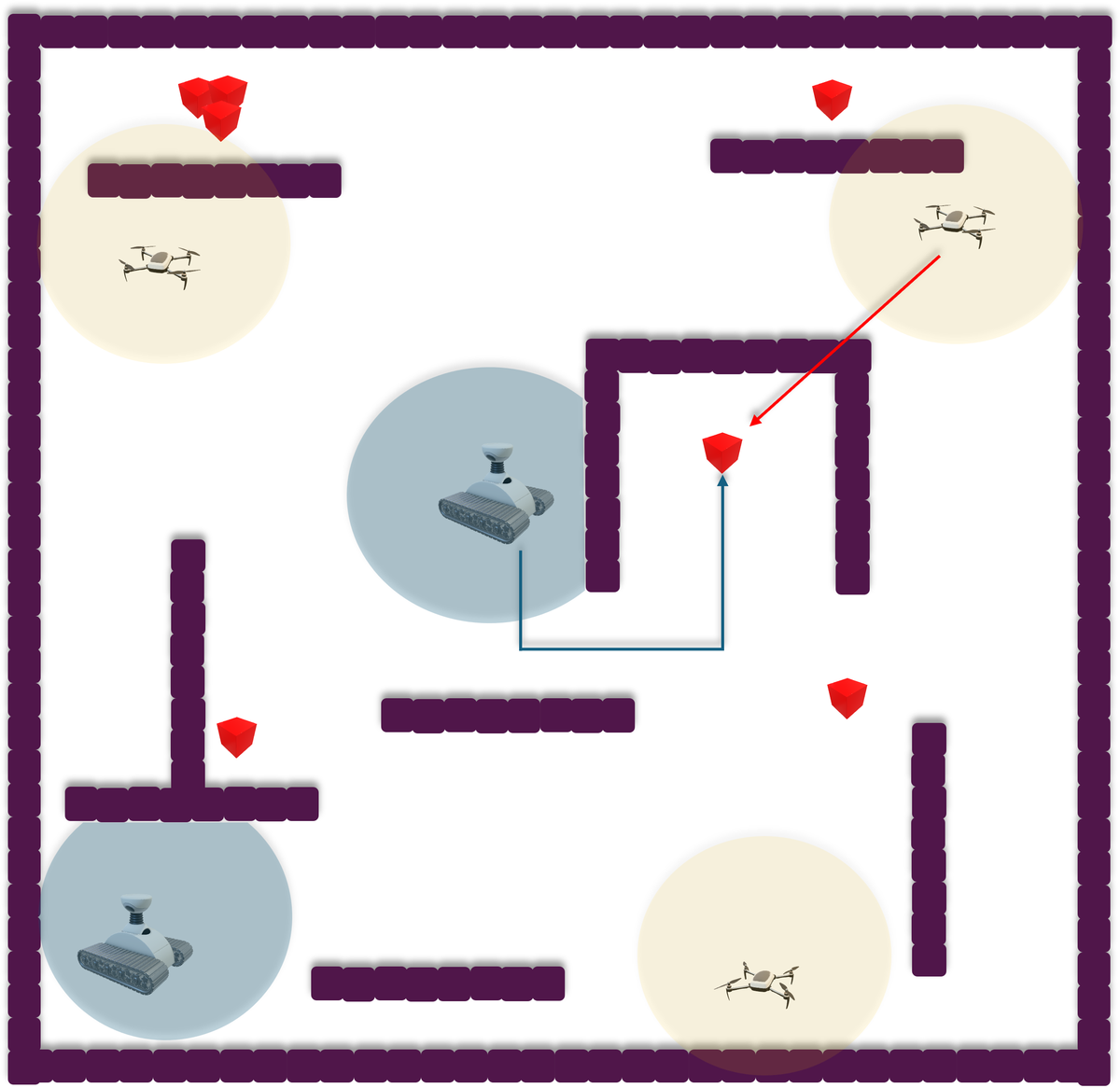
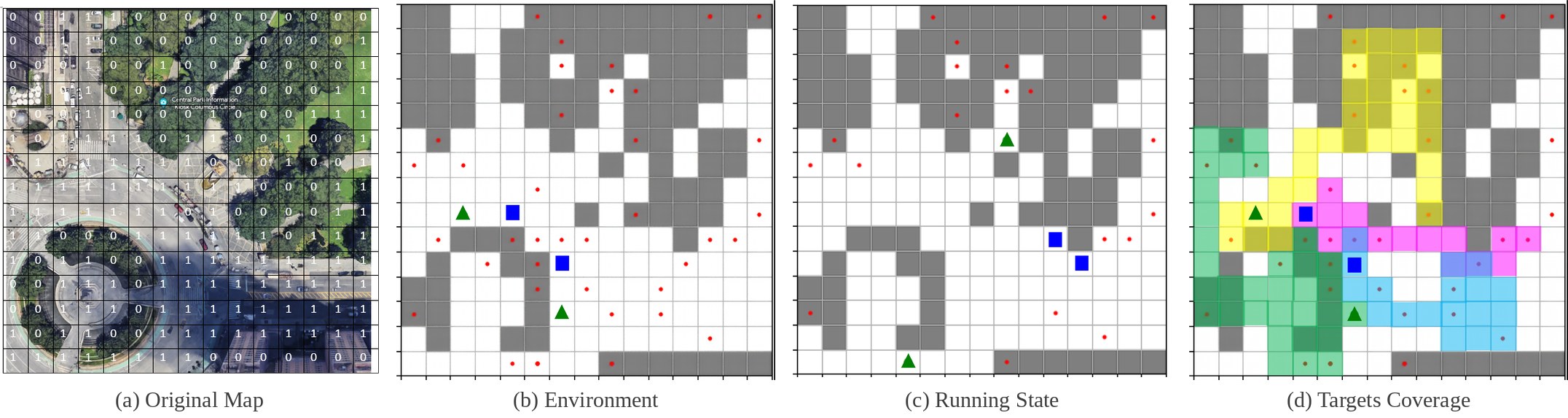
GATAR is a decentralized graph neural operator that allocates localization targets across mixed teams of ground (UGV) and aerial (UAV) robots by aggregating information from each robot's neighbors. A heterogeneity-aware preprocessing step encodes how the robot types differ, and a single trained model handles teams of 2 to 12 robots while outperforming baseline architectures.
Method
Heterogeneity-aware observation preprocessing
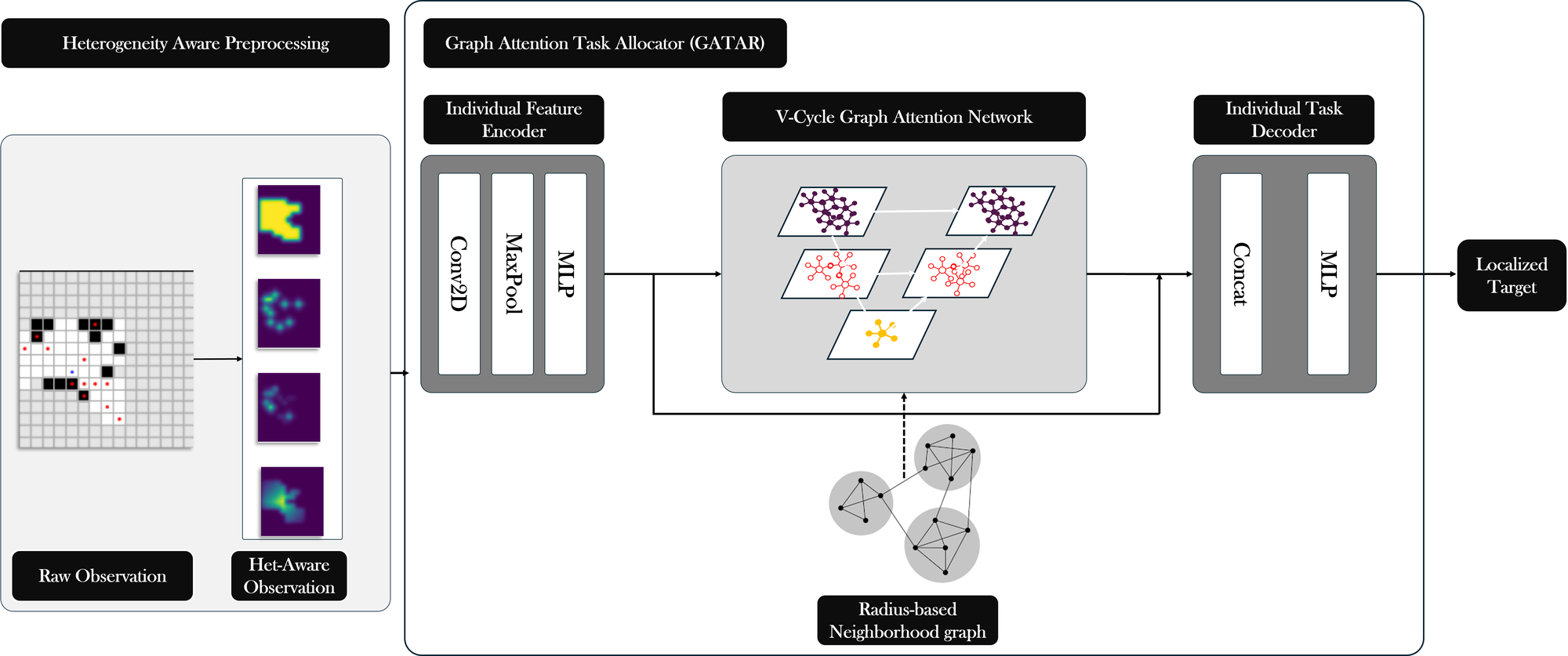
Robots differ in perception (whether ground obstacles occlude their line of sight) and mobility (whether ground obstacles impede them). Each robot encodes both into a four-channel spatial feature map: a reward map that favours regions reachable by short paths, a Gaussian target map centred on each observed target, a Boolean map of observed obstacles, and the pixel-wise product of the reward and target maps. The reward for robot \(i\) moving to a location \(l\) in its observed region \(E_i\) is
where \(v_i\) is the robot's velocity and \(d_{i,l}\) the length of the shortest path to \(l\).
Graph Attention Task Allocator
Robots exchange their local features with every neighbor inside a communication radius. To capture long-range information with linear complexity, GATAR adapts the V-cycle of the Multipole Graph Kernel Network: the radius graph is decomposed into levels, information is passed down and back up through them, and each level uses multi-head graph attention to weight a varying number of neighbors. The residual V-cycle structure also counters over-smoothing, which would otherwise assign the same task to every robot in a neighborhood. The model is trained with supervision from a centralized greedy expert, and runs fully decentralized at test time.
Results
Task allocation on a real-world map
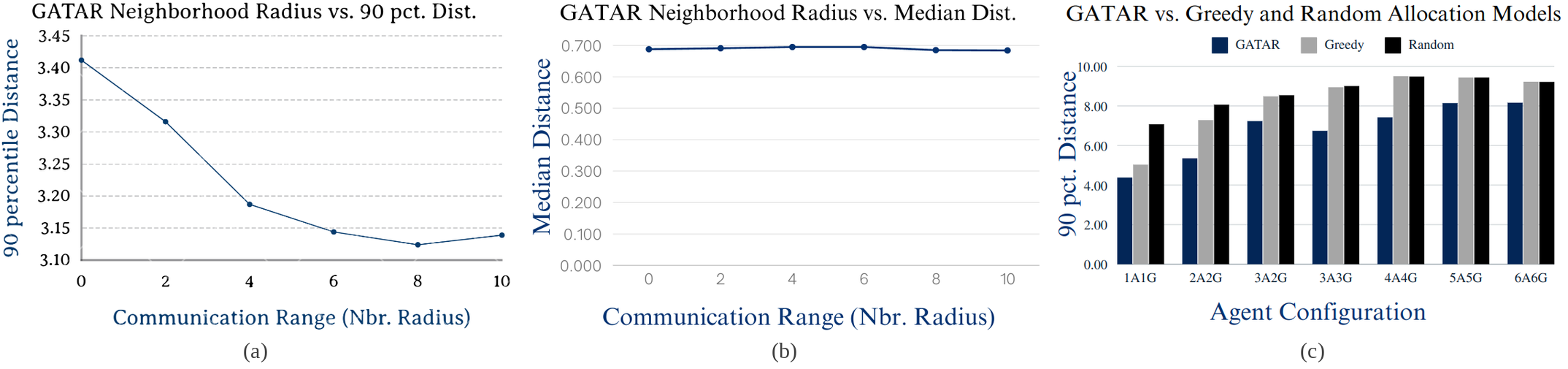
Communication range and team size
Against learned baselines
| Method | 90-pct. dist. ↓ | median dist. ↓ | mean dist. ↓ |
|---|---|---|---|
| GATAR | 4.3928 | 0.8156 | 1.6308 |
| GNN | 4.5618 | 0.8755 | 1.7180 |
| GNN + V-Cycle | 4.6152 | 0.8452 | 1.6996 |
| MAGAT | 5.4553 | 0.8588 | 1.8746 |
Distance between predicted and expert-assigned targets, 6 UAVs + 6 UGVs.
Citation
@article{peng2024graph,
  title   = {Graph-based Decentralized Task Allocation for Multi-Robot Target Localization},
  author  = {Peng, Juntong and Viswanath, Hrishikesh and Bera, Aniket},
  journal = {IEEE Robotics and Automation Letters},
  year    = {2024}
}