GIOROM
TL;DR
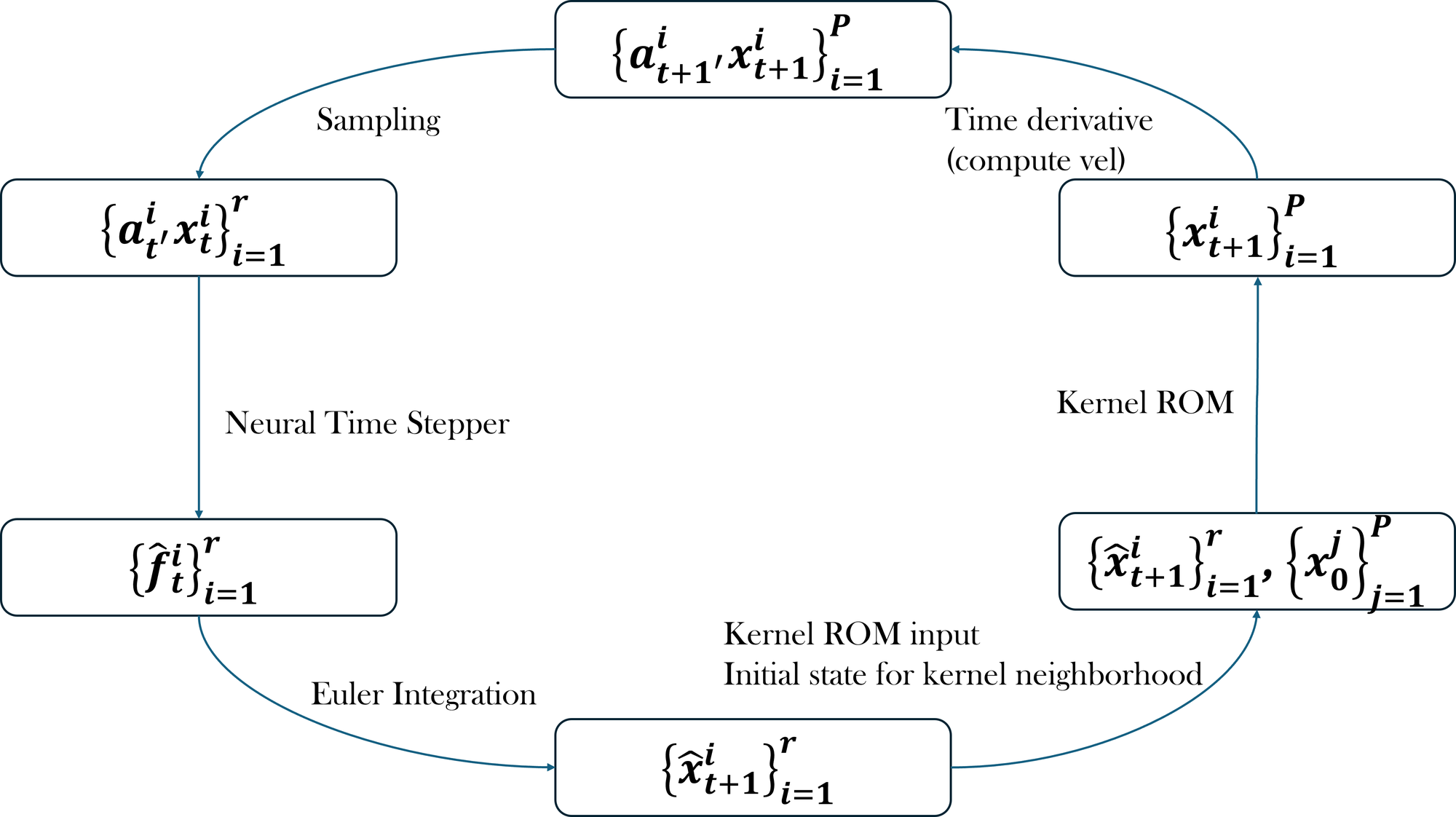
GIOROM simulates Lagrangian systems by evolving only a sparse sample of the particles with a data-driven neural PDE operator, instead of a global latent state. A learnable kernel then reconstructs the full field at any location from the evolved particles, cutting active degrees of freedom by 6.6×–32× while staying accurate on fluids, granular media and elastoplastic materials.
Sampling-Based Reduction
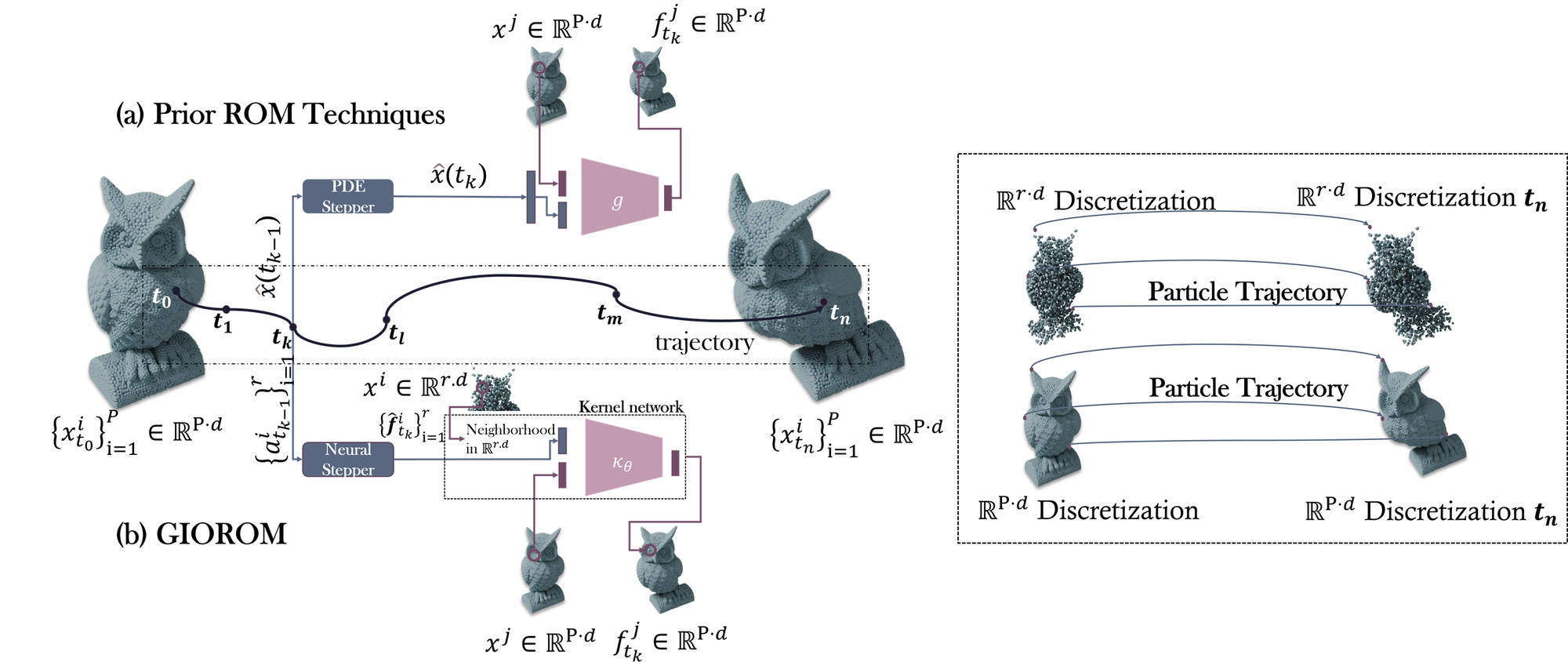
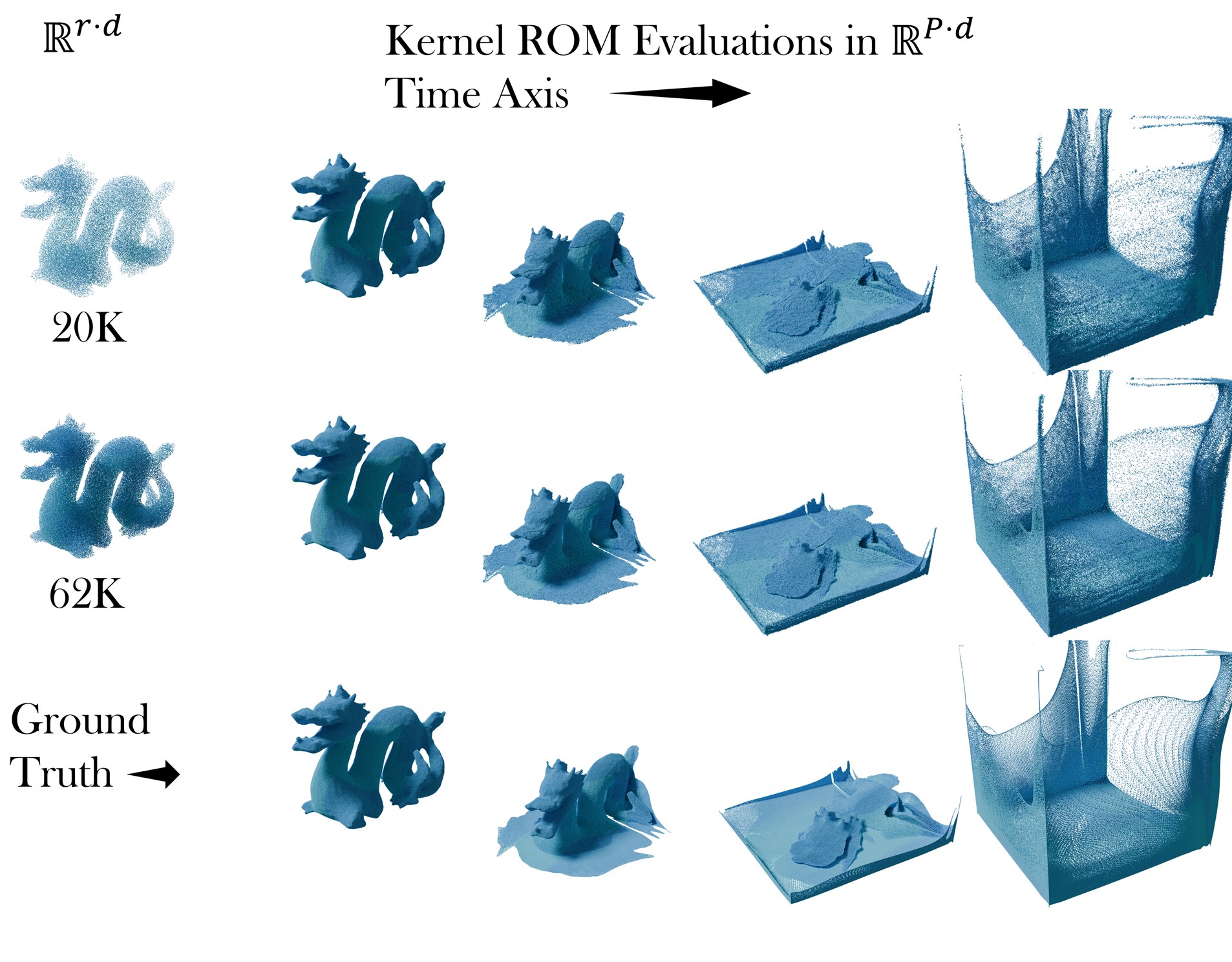
Classical ROMs project the state onto a fixed global basis and evolve its coefficients with reduced forms of the governing equations; neural-field ROMs then decode the latent state back to the full field. These global latents struggle with complex, fast-evolving local dynamics such as fluids, and still need the PDE to time-step. GIOROM instead evolves a small set of representative particles embedded in the physical domain with a data-driven Lagrangian solver, which preserves locality and needs no explicit governing equations, then reconstructs the full field from those particles with a discretization-invariant kernel.
Method
Kernel-integral ROM
Instead of a projection onto a global basis, the reduced-order model is a continuous integral operator with a learnable kernel \(\psi\). Given particle samples \(v \approx u\) produced by the time-stepper, the field at a query point \(x\) is a normalized, locally weighted aggregation of nearby samples, a continuous analogue of Nadaraya–Watson kernel regression:
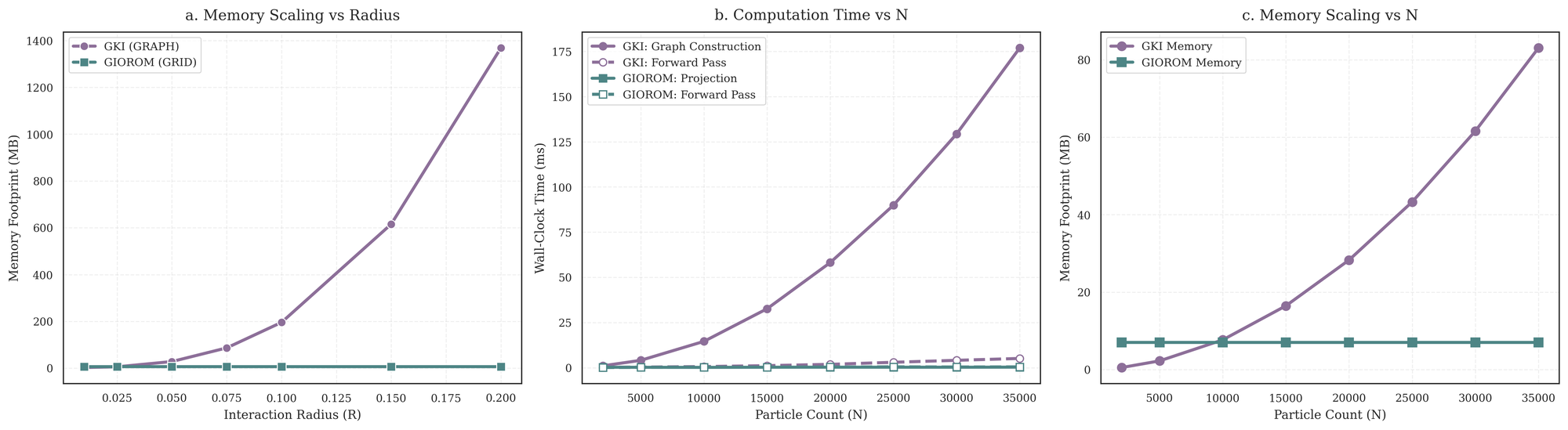
Evaluating this over radius graphs scales poorly, so the samples are projected onto a fixed grid with trilinear basis functions, giving a feature field \(F_{grid}\) and a density field \(D_{grid}\), and the operator is approximated by stochastic interpolation around \(x\), where \(\xi \sim \mathcal{N}(0, \sigma^2 I)\) acts as a Monte Carlo Gaussian smoothing kernel:
Time-stepping on the reduced sample set
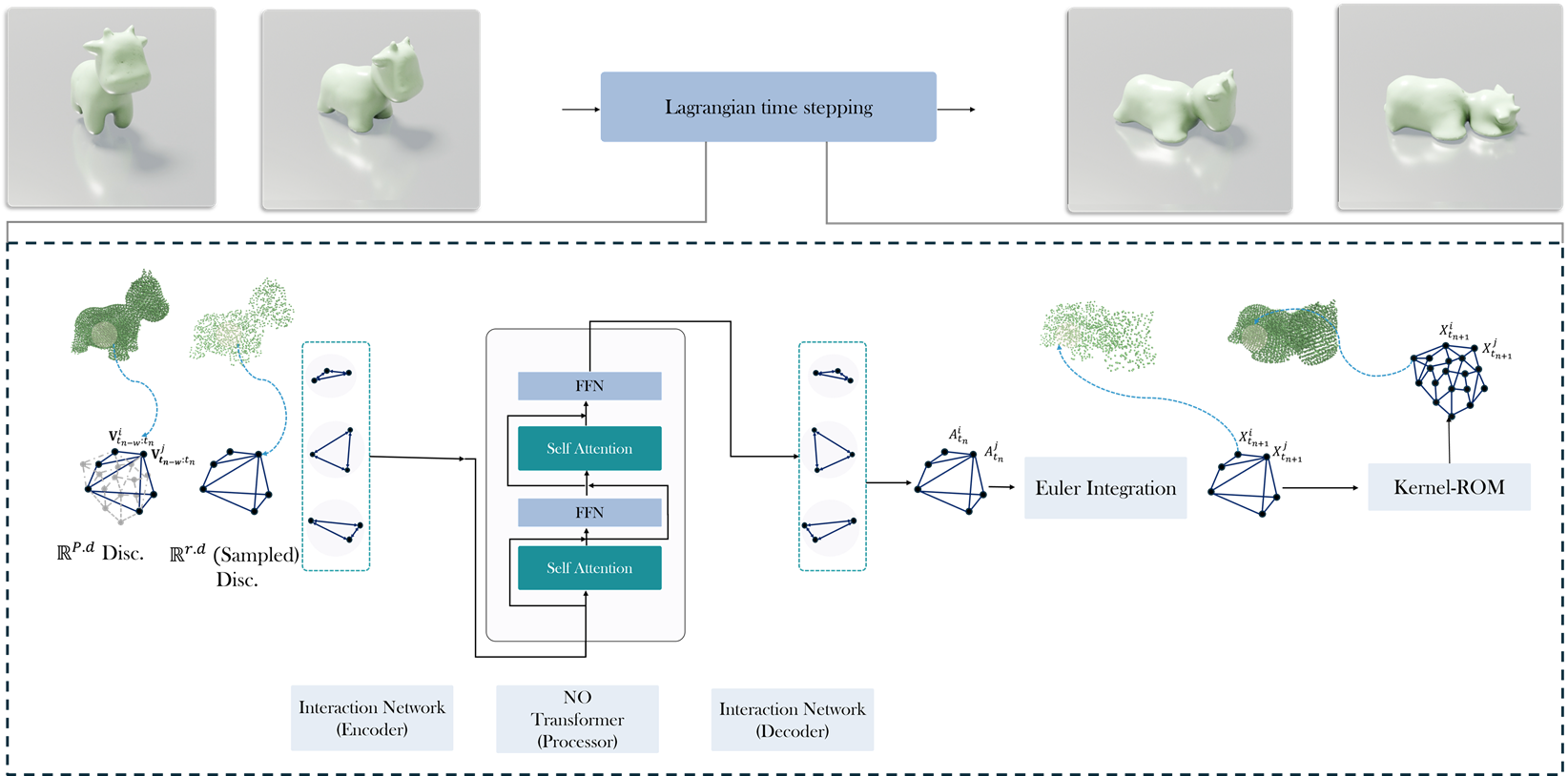
The sparse particles are advanced by a neural PDE operator that adapts the UPT encode–process–decode architecture to autoregressive particle dynamics, with interaction-network encoder and decoder on a radius graph over the sample and a transformer processor in latent space: \(\phi_\Theta := IN^{dec} \circ NOT^{process} \circ IN^{enc}\). From a window of velocities \(\mathbf{v}_{t-w:t}\) it predicts per-particle accelerations, and positions follow by Euler integration. Mean aggregation in message passing makes the graph layers behave like a Monte Carlo approximation of kernel integrals, so the operator stays consistent as the sample changes; training on several random subgraphs per domain makes it invariant to the sampling ratio. The framework is agnostic to the choice of time-stepper.
Results
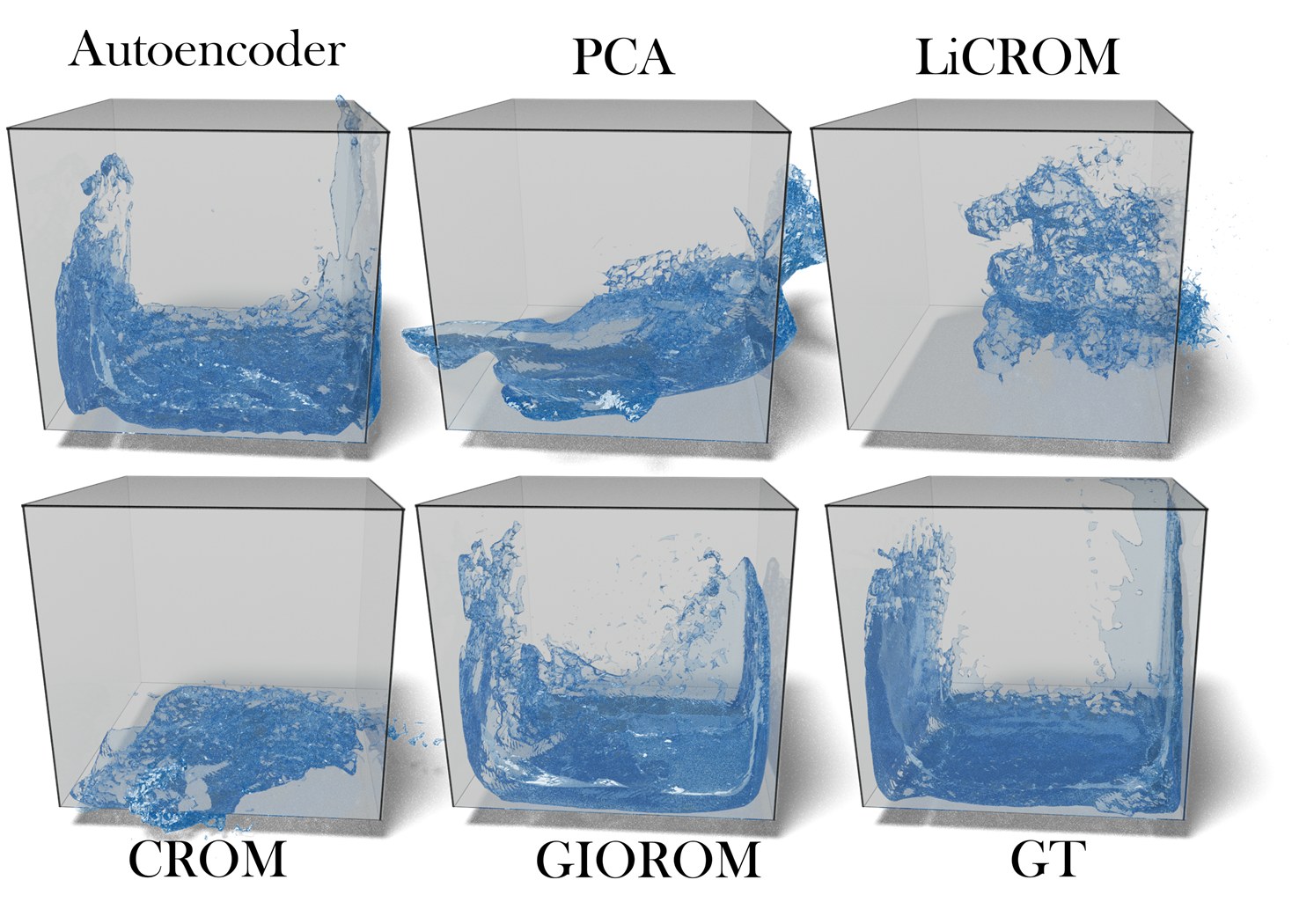
Reconstruction against neural ROMs
| Rel. \(L_2\) error (%) ↓ | Plasticine-3D | Sand-3D | Water-3D | Elasticity-3D |
|---|---|---|---|---|
| PCA | 16.15 | 13.37 | 15.84 | 39.41 |
| DINo | 31.83 | 45.36 | 58.97 | 41.18 |
| CORAL | 21.85 | 25.80 | 53.71 | 46.24 |
| CoLoRA | 9.08 | 12.31 | 54.54 | 9.83 |
| CROM | 3.19 | 4.21 | 24.00 | 4.25 |
| LiCROM | 2.31 | 3.44 | 22.01 | 3.43 |
| GKI | 3.69 | 8.46 | 15.16 | 7.66 |
| GIOROM | 1.98 | 2.68 | 9.24 | 2.04 |
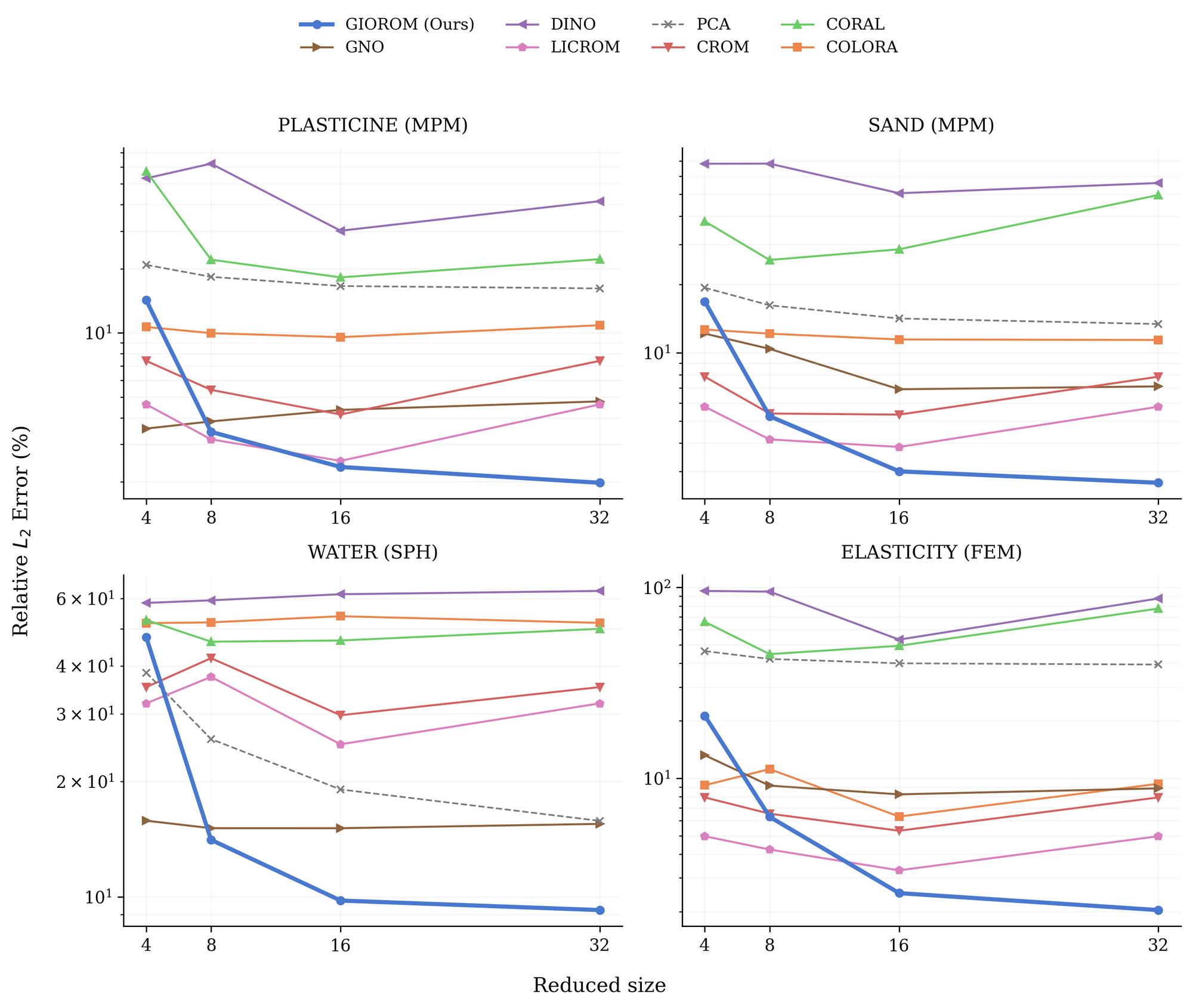
Unseen trajectories, 32 effective active degrees of freedom. GIOROM's peak memory is 17–268 MB, against 462–2970 MB for the graph-kernel baseline GKI and ≈400–630 MB for the latent-ODE ROMs.
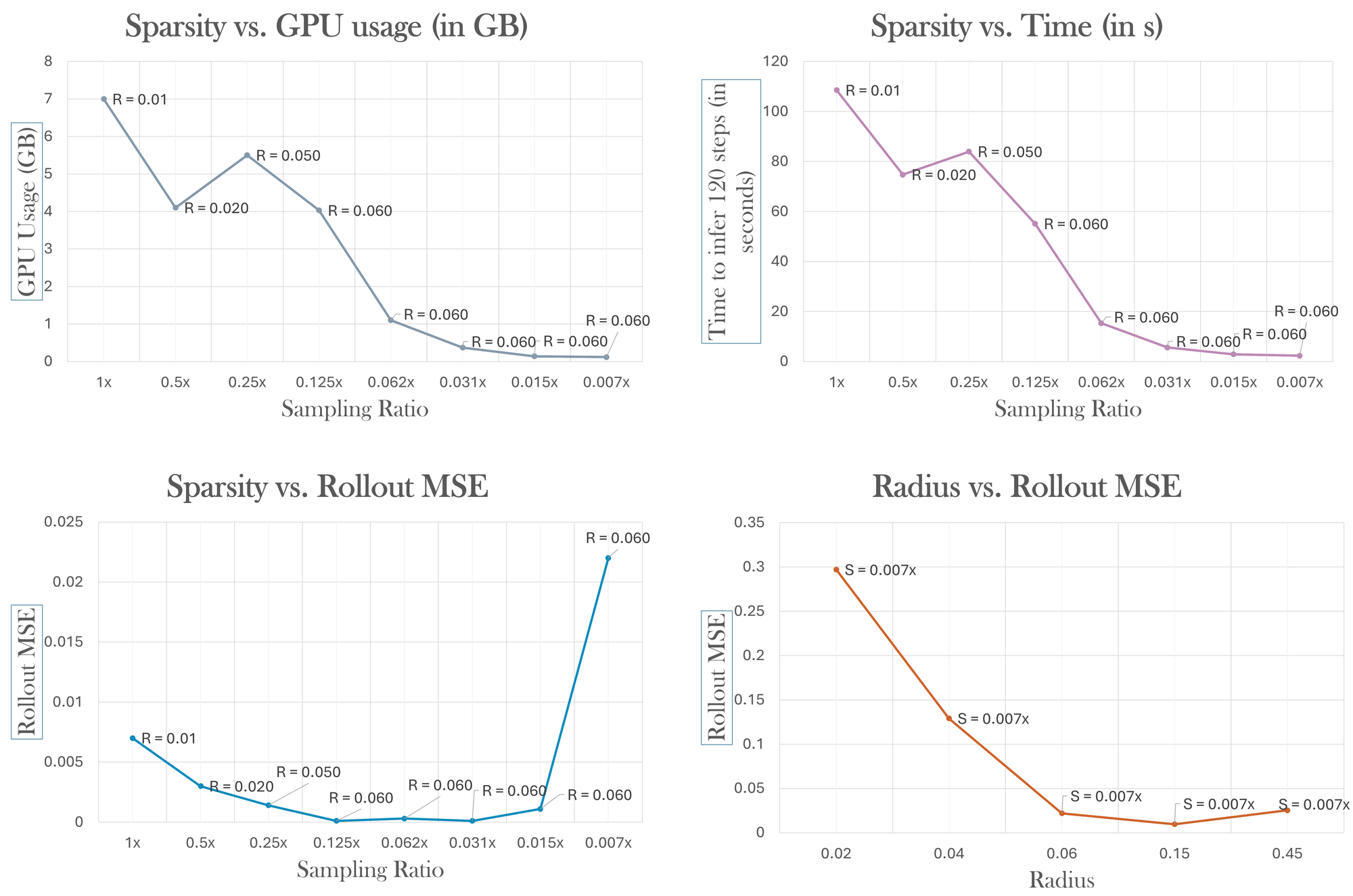
Effect of the reduced space
Against a full-order solver
| System | \(N\) | \(r\) | Scale | Rollout MSE (Ours) | Rollout MSE (GNS) |
|---|---|---|---|---|---|
| Water-3D | 55k | 1.7k | 32× | 38.6 | 17.4 |
| Water-2D | 1k | 0.12k | 8.3× | 6.70 | 7.55 |
| Sand-3D | 32k | 1k | 32× | 0.25 | 0.31 |
| Sand-2D | 2k | 0.3k | 6.6× | 1.34 | 1.21 |
| Goop-2D | 1.9k | 0.2k | 9.5× | 0.94 | 0.55 |
| Plasticine | 5k | 1.1k | 4.5× | 0.50 | 0.71 |
| Elasticity | 78k | 2.6k | 30× | 0.20 | 0.30 |
| Multi-material 2D | 2k | 0.25k | 8× | 9.43 | 12.1 |
Rollout MSE (×10−3) computed on the full particle set, with GIOROM evolving a graph up to 32× smaller than GNS. Errors stay within the same order of magnitude as the full-order oracle.
| 200-step rollout, 7056 points | radius 0.040 | 0.060 | 0.080 | 0.100 |
|---|---|---|---|---|
| GIOROM | 20.1 s | 47.6 s | 89.7 s | 109.3 s |
| GNS | 43.5 s | 111.6 s | 226.2 s | 386.0 s |
A transformer processor replaces recursive message passing, so the speedup widens from about 2× to 3.5× as connectivity grows.
Scalability
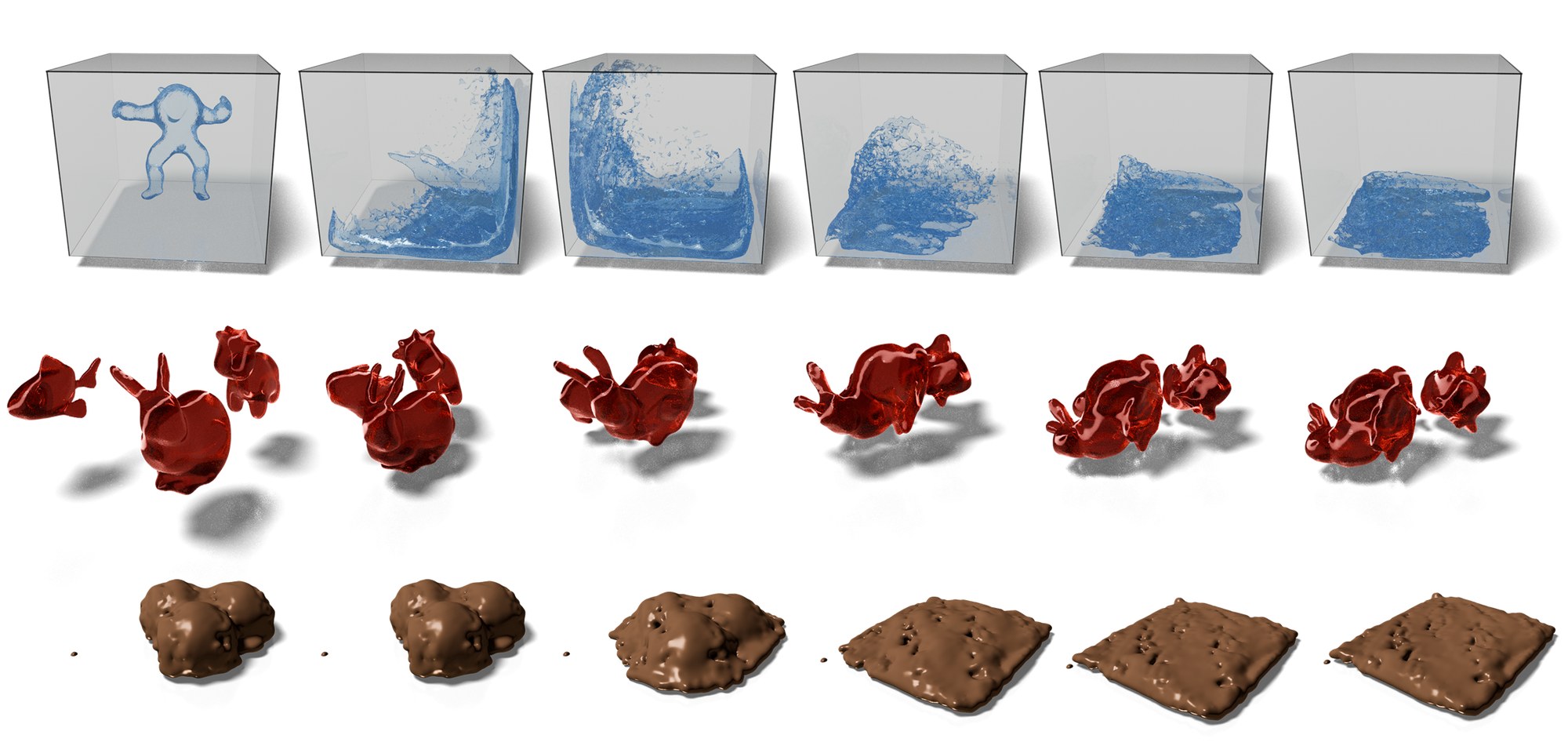
Rollouts
Limitations
In ultra-sparse regimes, when the sampled particle count leaves almost no active grid voxels, the estimator becomes ill-conditioned and the network falls back on its prior without local physical guidance. Like other learned ROMs, GIOROM degrades under extreme out-of-distribution conditions. It currently targets continuous systems with consistent time discretizations and Euler integration; discontinuities, unbounded flows, higher-order integrators and adaptive time-stepping are left to future work.
Citation
@article{viswanath2026learning,
  title   = {Learning Lagrangian Interaction Dynamics with Sampling-Based Model Order Reduction},
  author  = {Hrishikesh Viswanath and Yue Chang and Aleksey Panas and Julius Berner and Peter Yichen Chen and Aniket Bera},
  journal = {Transactions on Machine Learning Research},
  issn    = {2835-8856},
  year    = {2026},
  url     = {https://openreview.net/forum?id=vXCQA1EzaG},
  note    = {Expert Certification}
}